
Flat Roof Repair by Roofing System
"Flat" roofs aren't quite flat. The code requires a design slope of at least ¼ inch per foot on modified bitumen, single-ply, foam and most built-up roofs, and ⅛ inch for coal-tar built-up roofs. Each system is repaired differently.
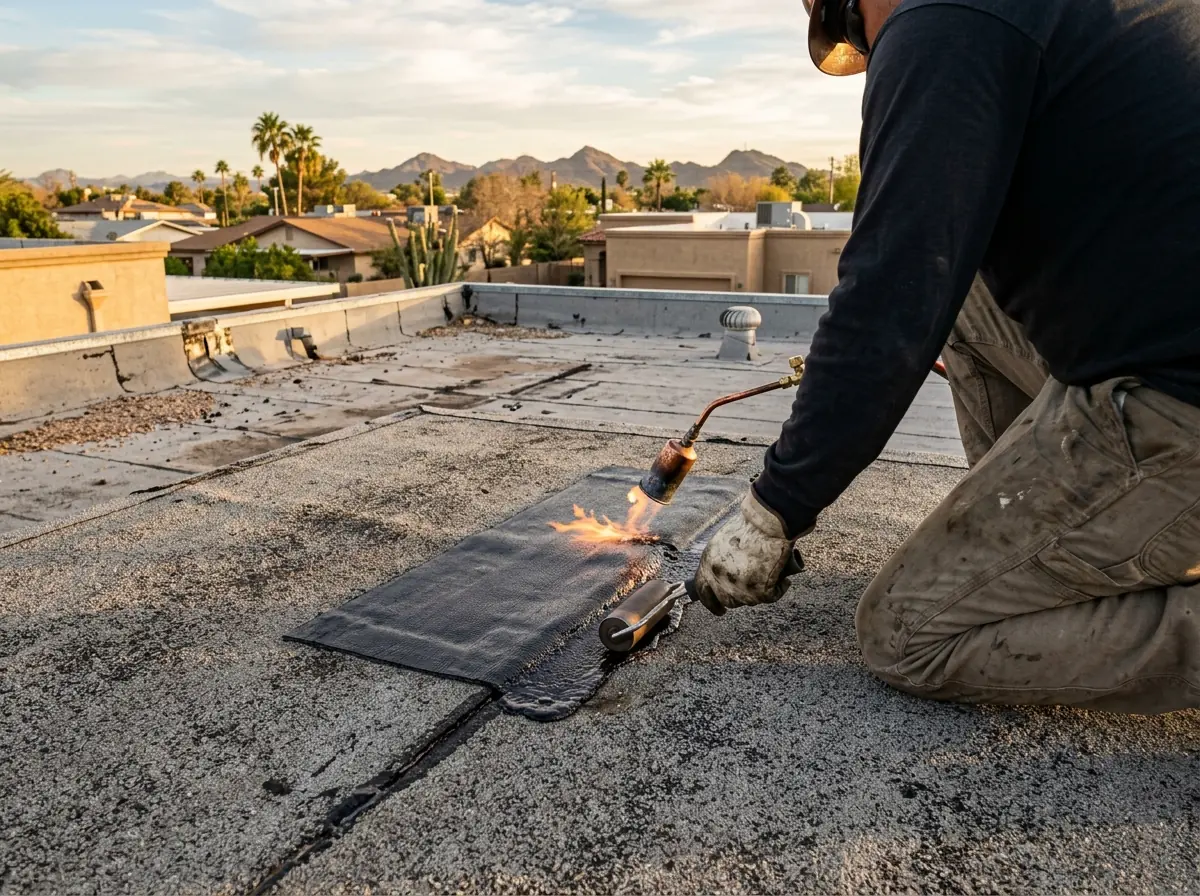
Modified Bitumen Repair
Modified bitumen is asphalt blended with polymers, applied in rolled sheets that are torched, cold-applied or self-adhered. Repairs cover open laps, blisters, cracks in the granule surface and splits at the edges. The patch has to be compatible with the existing sheet, and the edges around it sealed so water can't get under it.
Built-Up Roof Repair
Built-up roofing (BUR) is layers of felt and asphalt, often finished with gravel or a coating. Repairs cut out blistered or split plies, build the patch back up in layers, and restore the surface. A built-up roof in fair condition can also take a restoration coating without a tear-off, which the code allows as long as the roof isn't water-soaked or deteriorated.
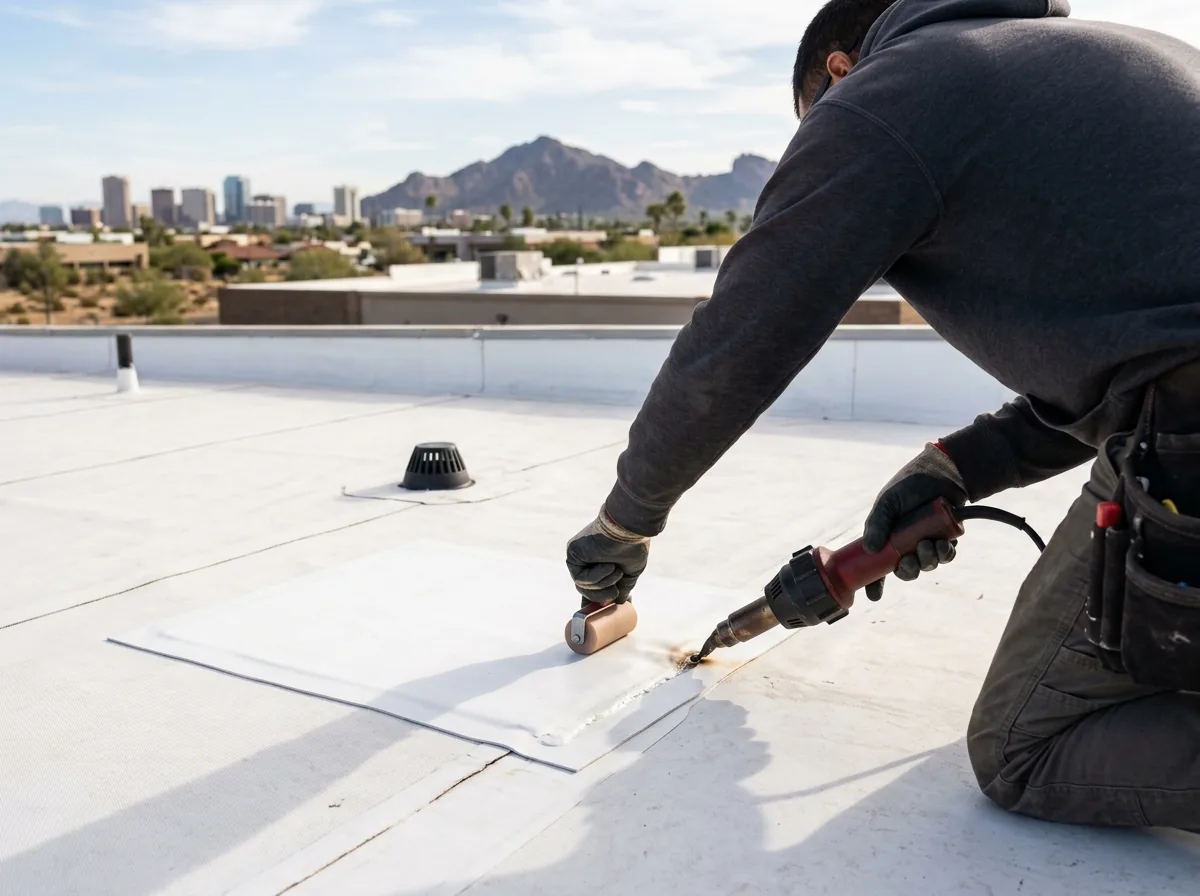
TPO Membrane Repair
TPO is a white thermoplastic single-ply membrane with heat-welded seams. Repairs clean the membrane, then heat-weld a TPO patch over punctures or failed seams. Our view: adhesive tape patches are a stopgap, and a welded patch is the permanent fix.
Foam Flat Roofs
Spray foam roofs have their own repair process: cutting out damaged foam, refilling it and recoating. See foam roof repair.
Why Tempe homeowners call Tempe Expert Roofing
- Free, no-obligation roof estimates
- Written scope: tear-off, underlayment, flashing, coating
- Photos of every finding on your roof
- Permit and code questions answered up front
- One call, one local roofer
What Affects the Cost of a Flat Roof Repair
- The roofing system and whether its materials are still made.
- How much of the insulation or deck under the damage is wet.
- Ponding areas that need to be built up.
- Parapet, scupper and rooftop equipment details.
Drainage, Parapets and Scuppers
Flat roofs have two weak points: water that stays on the roof, and edges that let it in.
Drains and scuppers
Unless a roof sheds water over its edges, the code requires a drain at each low point. A blocked scupper turns a flat roof into a shallow pool, so clearing and reflashing scuppers is often part of the repair.Ponding
Low spots that hold water after rain wear any covering faster. Repairs can build up the low area with tapered insulation, foam or extra plies so it drains.Parapets
The cap and the joint where the roof turns up the wall need sound flashing. The code requires flashing wherever a roof meets a wall.Reroofing
When a flat roof is re-covered or replaced, the existing slope can stay as long as the roof drains positively, and the code doesn't require new secondary overflow drains or scuppers on an existing roof that already drains positively.
If the roof needs more than a repair, see roof replacement. For coatings over an existing flat roof, see roof coating.